Targeted Structure Completion for Sparse-View 3D Reconstruction in Autonomous Driving
Abstract
Reconstructing 3D scene structures from sparse, low-overlap observations remains a fundamental challenge in autonomous driving. Recent state-of-the-art frameworks achieve promising results by incorporating voxel-based Gaussians, but incur substantial computational redundancy due to a uniform volumetric processing strategy. To bridge the gap between the efficiency of pixel-based Gaussian methods and the structural completeness of voxel-based Gaussian approaches, we propose \textbf{FocusGS}, a simple yet effective framework that shifts the paradigm from global densification to targeted structural completion. Our central insight is that structural completion should be decoupled from deterministic regions, with computation concentrated exclusively on areas exhibiting geometric ambiguity. Specifically, FocusGS addresses the localization challenge by deriving a 3D Geometric Ambiguity Manifold to accurately isolate localized areas prone to occlusion and high geometric uncertainty. To overcome the subsequent manifold completion challenge, we design a lightweight target structure completion module that selectively instantiates and optimizes continuous Gaussian queries strictly within this unstructured, sparse topological subspace. Extensive experiments demonstrate that FocusGS achieves a superior efficiency-quality trade-off, advancing state-of-the-art performance on driving-centric benchmarks while naturally reducing the total number of Gaussians by ~74% and decreasing rendering time by ~34%.
Introduction
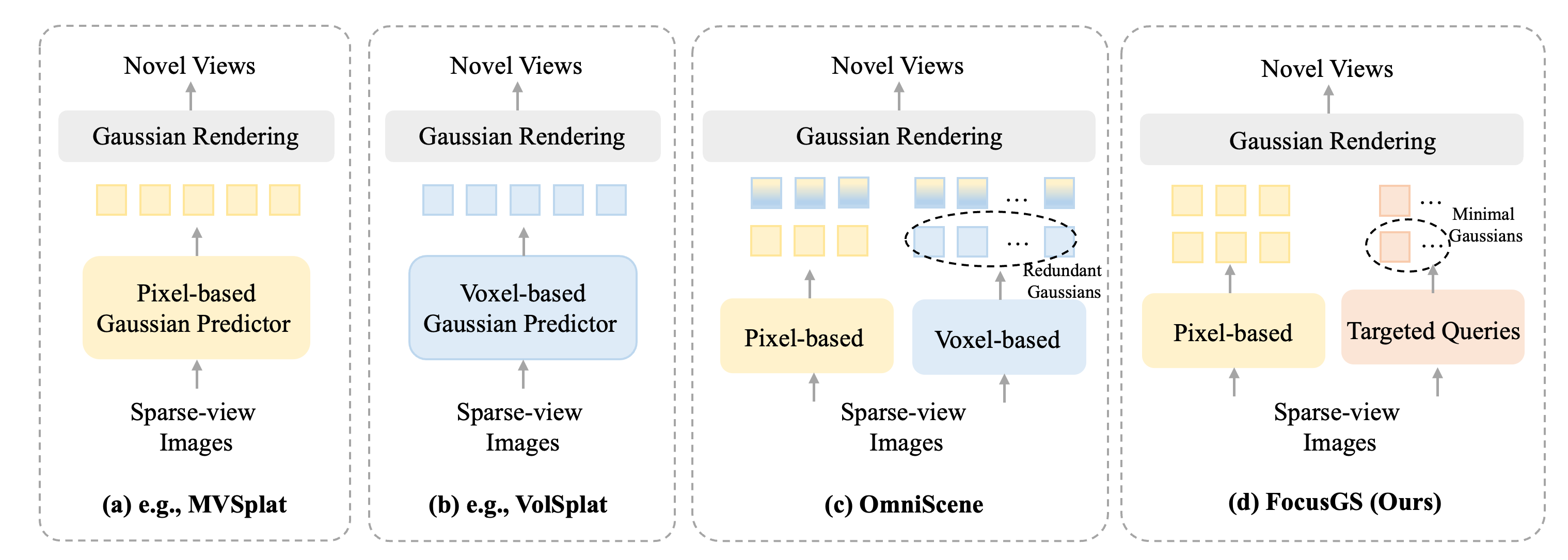
Comparison of feed-forward 3D Gaussian Splatting methods. (a, b) Prior works rely on either pixel- or voxel-based predictors. (c) OmniScene combines both but suffers from redundant Gaussians. (d) Our FocusGS introduces targeted structure completion based on pixel-based features, achieving high-fidelity reconstruction with minimal Gaussian overhead.
Method
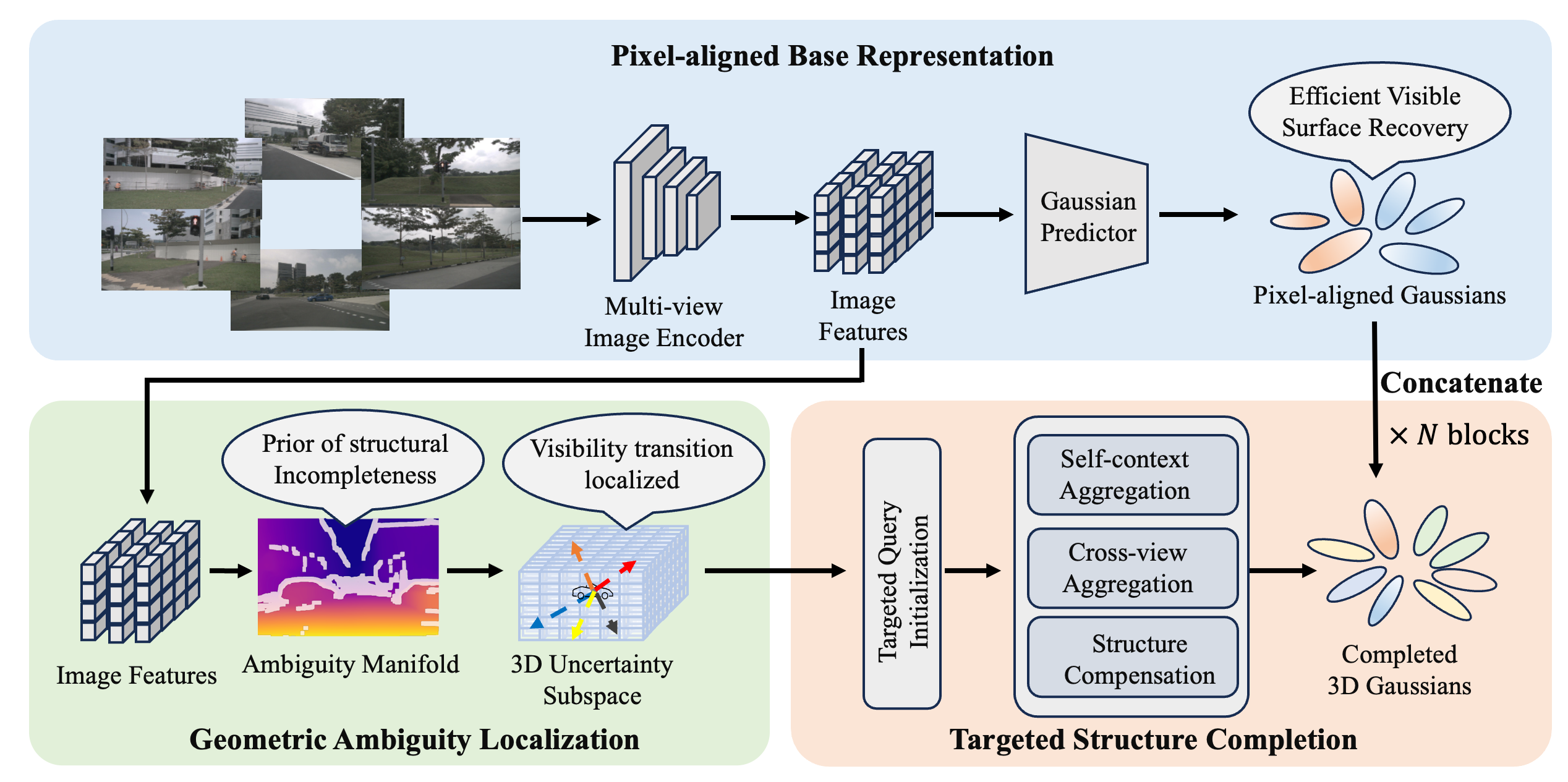
The overall pipeline of FocusGS. Given sparse multi-view images, we first generate a pixel-aligned base Gaussian representation for continuous visible surfaces. To handle occlusions and depth discontinuities, we explicitly localize regions of high uncertainty by constructing a geometric ambiguity manifold. A targeted structure completion module then initializes and optimizes Gaussian queries exclusively within this derived 3D uncertainty subspace, naturally bridging the gap between pixel-based efficiency and volumetric structural completeness.
Results
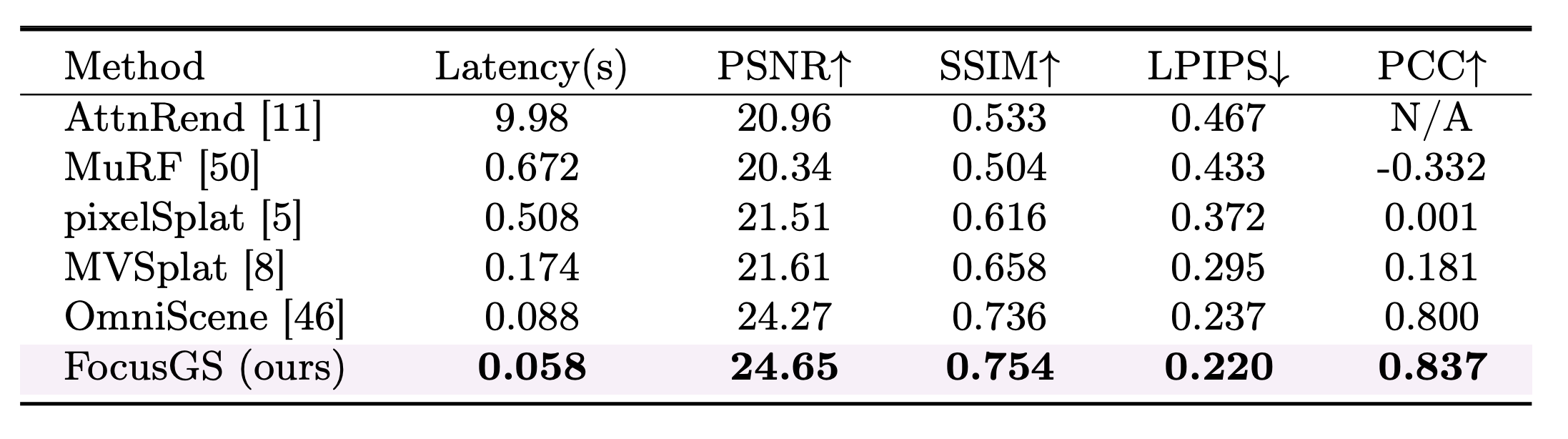
Quantitative results of the ego-centric reconstruction task on nuScenes. PCC is reported as N/A for AttnRend, since it does not produce an interpretable 3D structure for depth rendering.
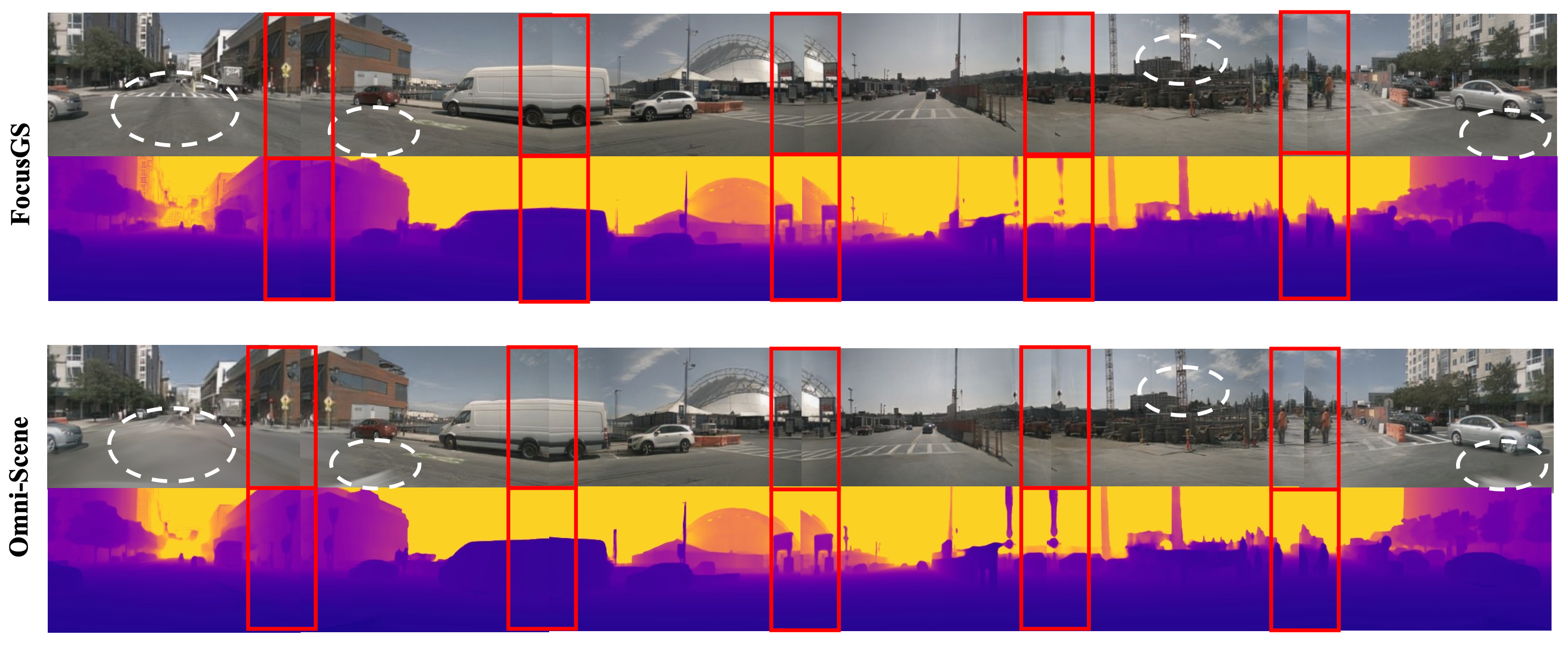
The qualitative comparison of reconstruction performance between OmniScene and our FocusGS (better viewed when zoomed in). We render six views to cover the full 360° panorama, ensuring approximately 15% overlap between adjacent viewpoints. The red boxes indicate the overlapping regions across different views.
BibTeX
@article{wang2026focusgs,
  title={Targeted Structure Completion for Sparse-View 3D Reconstruction in Autonomous Driving},
  author={Guoqing Wang and Pin Tang and Xiangxuan Ren and Liping Hou and Chao Ma},
  journal={European Conference on Computer Vision},
  year={2026},
}